
By Michael Earl Simmons
Down here, stories don’t always start in books.
Some start on sandy roads, under longleaf pines, with a name spoken low and slow, like you’re testing the air before a storm.
In the late 1800s, North Escambia County was thinly settled and thick with woods. Farms clung to the land where they could. Communities rose where people stopped long enough to build a church, a store, or a still. First along the rivers—the Escambia and the Perdido—then along the old trails that led north out of Pensacola. Those trails would become roads. Pensacola Boulevard would become U.S. Highway 29. Muscogee Road was already worn smooth by feet, wagons, and time.
As you headed north, you passed names that still echo today: Ensley. Gonzalez. Cantonment. Molino. McDavid. Bluff Springs. And finally Flomaton South, which folks would rename Century in 1900, like they were stepping into something new.
And somewhere in those piney woods, in the turpentine camps and along the steel rails of the Louisville & Nashville Railroad, a legend caught fire.
They called him Railroad Bill.

His given name was Morris Slater, and before the stories twisted him into something larger, he was just a working man. Strong. Quick. Well-liked. The kind of fellow who could outwork most men and still laugh at the end of the day. He’d traveled with a circus for a time, where he picked up a little showmanship, a little foot speed, and then followed the work south through turpentine camps in South Carolina, Baldwin County, Alabama, and into Bluff Springs, Florida.
People remembered him as good-natured. Until the day everything broke.
Sometime in the early 1890s, a railroad brakeman caught Slater riding a freight train without paying and shoved him off the moving cars. It wasn’t just the pain – it was the humiliation. And in that moment, Slater snapped back. He raised his rifle and fired.
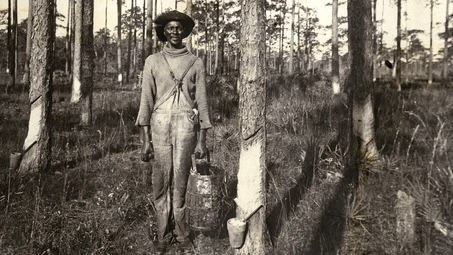
That single shot echoed a long way.
From then on, Morris Slater was no longer just a laborer. The railroad labeled him an outlaw, slapped a reward on his head, and, knowing almost nothing else about him, gave him a name they’d used before: Railroad Bill. Instead of running from it, Slater leaned into it. Wore it like armor.
What followed was part crime, part rebellion, and part folklore.
Railroad Bill didn’t just rob trains…he embarrassed them. He wounded trainmen who crossed him. Once, he climbed into a locomotive cab and forced the engineer to pull out under threat, steam hissing while the law watched helplessly. He organized freight thefts with precision: one man hidden inside a boxcar, tossing goods off the train at night, others gathering them up along the tracks.
Some said he gave to the poor. Some said he sold most of it back to the company stores in the camps. Either way, to people ground down by railroad power and company rules, Railroad Bill became something else entirely. He became a symbol that the iron horse could be challenged.
The escapes made the legend.

In 1895, at Hurricane Bayou, trainmen found him asleep near a water tank. They took his guns, then woke him like they already had him beat. Railroad Bill bolted, ran a hundred yards, drew a hidden revolver, and turned on them. When they tried to corner him, he leapt into the cab of a passing locomotive, forced it forward, and vanished into the swamps as bullets cracked the air.
Lawmen chased him through barns and backwoods. A deputy died in a shootout near Bay Minette. Sheriff Edward S. McMillan swore he’d bring Bill in and never came back alive. Rewards climbed…and $1,250 was serious money, drawing Pinkertons, bounty hunters, and posses from across state lines.
Still, Railroad Bill slipped away.
People started whispering. Said he could turn into a bird, or a dog, or even a stump to fool the hounds. In the quarters and camps, African American balladeers sang about him as a “bad man” who outran the law, a figure of defiance in a world stacked hard against them.
The legend finally ended not in the woods, but in a store.
On March 7, 1896, Railroad Bill sat easy in a general store in downtown Atmore, Alabama, his back turned, talking like any other customer. Constable Leonard McGowin stepped inside, saw him there, and fired – no warning, no words. Bill rose, reaching for his guns, but more shots followed. He staggered a few steps and fell.
That was it.
What came after feels almost crueler than the chase. His body was embalmed and hauled from town to town, displayed for a quarter a look, until authorities finally shut it down. On March 30, 1896, Railroad Bill was buried in the African American section of St. John’s Cemetery in Pensacola. No marker. No name. Just dirt and time.
For more than a hundred years, the grave was lost.
Then, in 2012, it was found. A headstone was placed at last.

By then, the man had long since given way to the myth. His story lived on in a ballad that was recorded by everyone from Bob Dylan to Taj Mahal, about trains, guns, and impossible escapes. Morris Slater became Railroad Bill forever: a turpentine worker turned outlaw, a folk hero born on sandy roads and steel rails, who reminded people that even in the age of iron, a quick step and a quicker wit could still make history flinch.
And around here, if you listen close when a freight train rolls north through Escambia County late at night, some folks will tell you the story isn’t quite finished yet.
Michael Earl Simmons is a retired police officer, trainer, author, and storyteller. His books are available on Amazon.
